
Robinson Criminal History Checks
Choose the custodian by the event being researched. Robinson Police creates city incident, accident, arrest, warning, citation, and related enforcement records. The county jail records intake and release. Crawford Circuit Court records filed criminal, traffic, and ordinance cases. ISP assembles reported Illinois criminal-history information.
- Check Robinson Police's readily available daily blotter when a summary is enough.
- Request the city report with the date, location, report number, and desired format.
- Use the Crawford jail channel for booking or present-custody information.
- Search Judici and contact the Circuit Clerk for the filed case and documents.
- Use ISP CHIRP or the appropriate fingerprint process for the authorized statewide purpose.
Three Robinson Counters, Three Records
Robinson concentrates county government, but the offices are not interchangeable. Police and City Hall share 300 South Lincoln Street. The Sheriff and Jail are at 203 South Jefferson Street. The courthouse is at 1 Court Street, with the Circuit Clerk on the second floor. Probation and the State's Attorney are at 105 Douglas Street. Walking into the nearest counter may therefore produce a referral rather than the record.
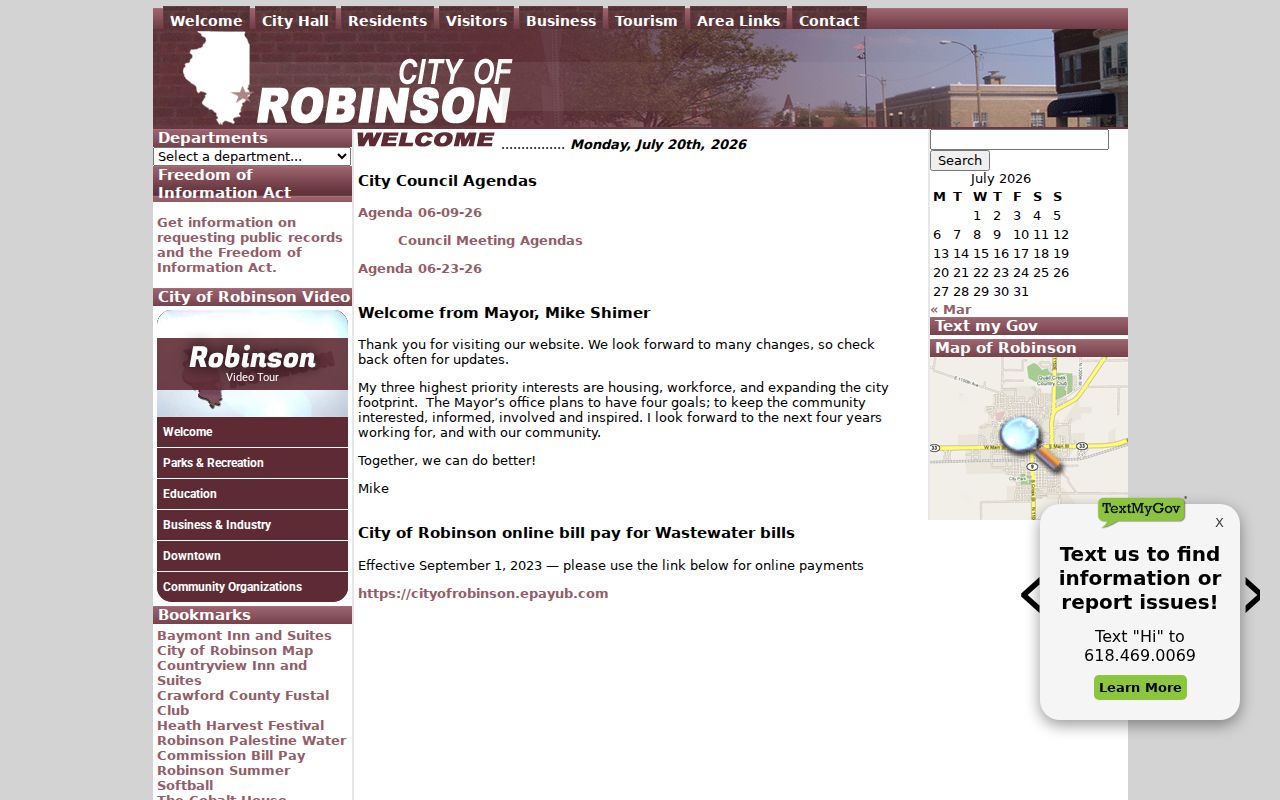
The official Robinson homepage identifies the city government starting point.
Records at the Robinson Police Department
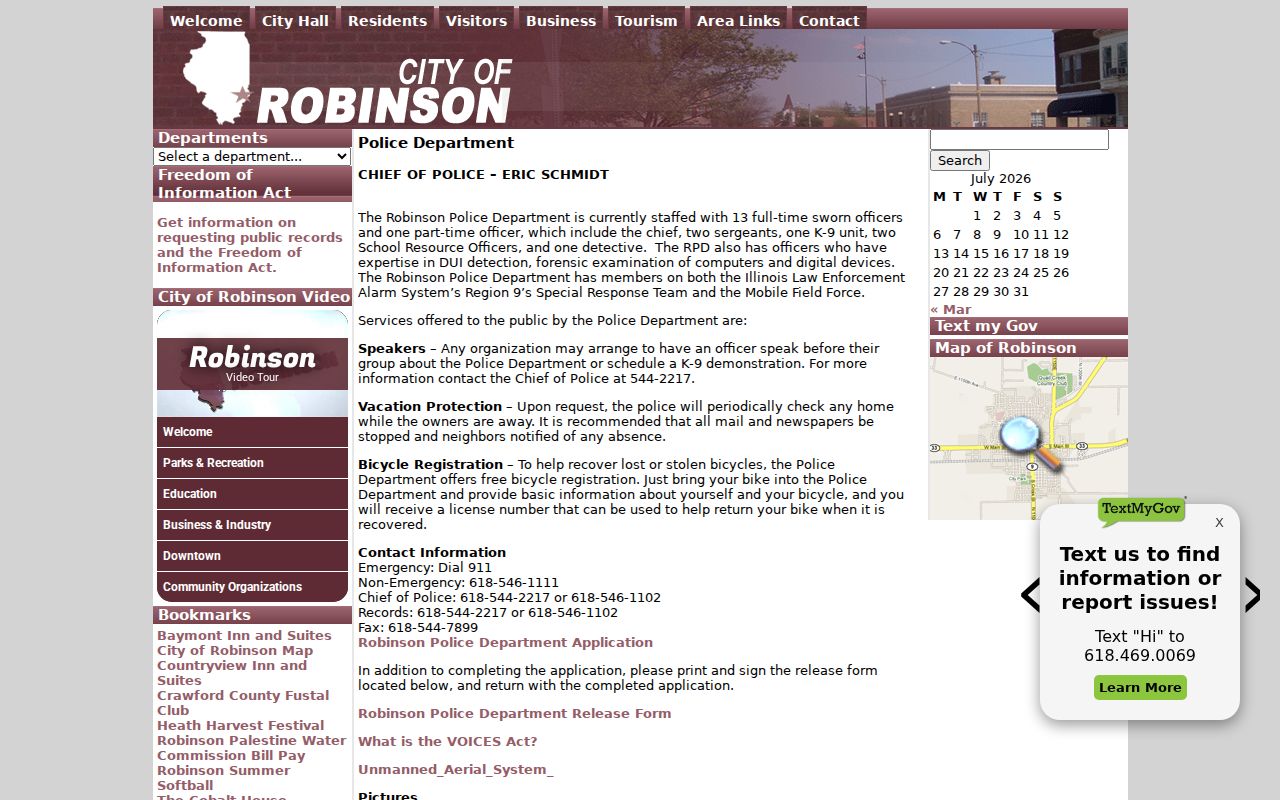
Robinson Police is at 300 South Lincoln Street, Robinson, IL 62454, with mail to P.O. Box 188. The records contact number is 618-544-2217; the department also publishes 618-546-1102 and nonemergency 618-546-1111. The current official page identifies Chief Eric Schmidt and FOIA officer Breanna Leek. It describes 13 full-time sworn officers, one part-time officer, two sergeants, a detective, K-9, and two school-resource officers, with capabilities including DUI detection and digital-device forensics.
The current Police Department page provides official staffing and contact context.
Inside Robinson Police's Records Catalog
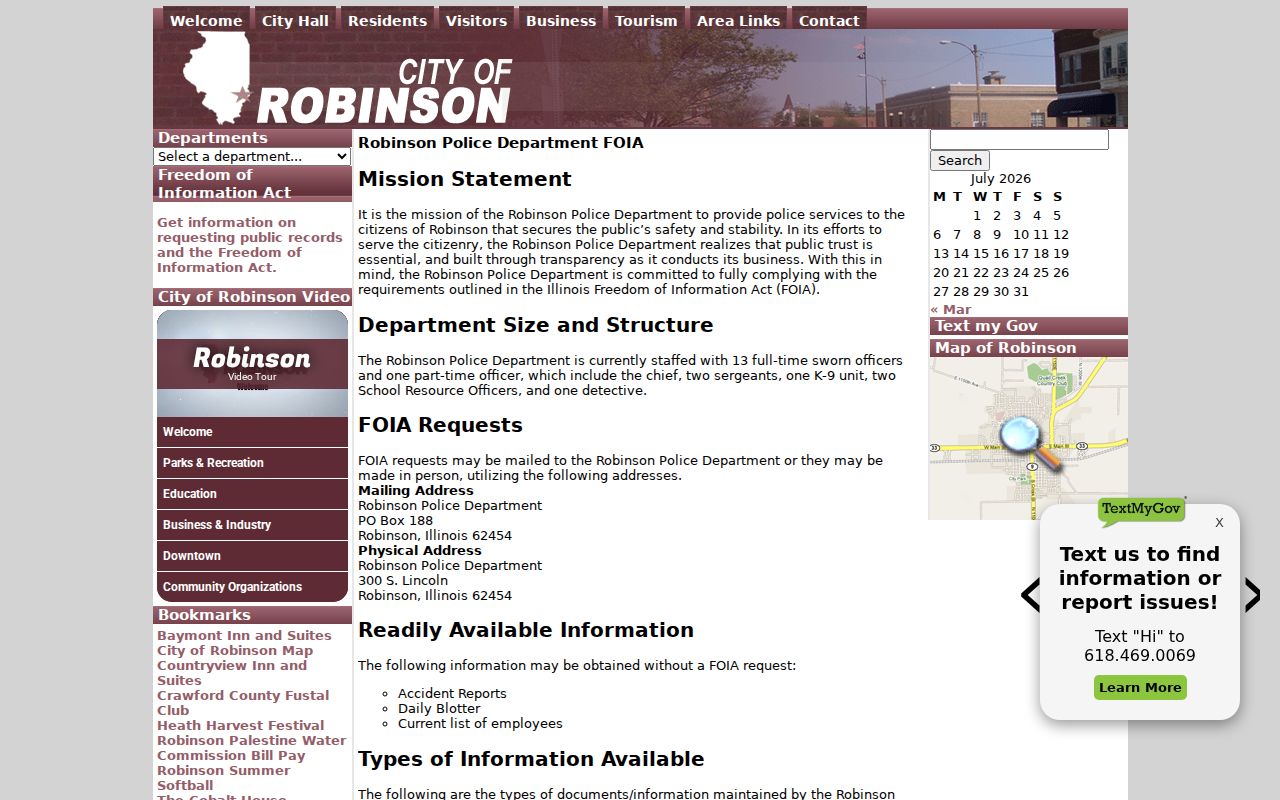
Accident reports, the daily blotter, and the current employee list are described as readily available without a FOIA request. Other holdings include arrest reports and statistics, evidence cards, laboratory submissions, court notices, warnings, incident reports, tow reports, audiovisual logs and interviews, solicitation permits, UCR material, and forfeiture records. Robinson's unusually detailed catalog also identifies tavern bans and altercation notifications, explosive permits, firearm-license or gun-sale records subject to law, and under-21 liquor dispositions.
No fixed online police request form is exposed. A useful free-form letter states the requester's contact information, exact record, incident date, approximate time and location, report number if known, inspection or copy preference, desired electronic or paper format, and whether certification is requested. These are practical recommendations, not mandatory fields published by the city.
The official Robinson Police FOIA page lists the available categories and officers.
Robinson's 50-Page Rule and Certification Fee
Robinson accepts oral or written public-record requests in person, by mail, fax, or email. The first 50 black-and-white letter or legal-size pages are free. Additional pages may cost up to $0.15 each. Color, oversize, electronic-media, and other nonstandard copies may be charged at actual reproduction cost, and certification is $1. The city may reduce or waive fees when the principal purpose benefits public health, safety, welfare, or legal rights rather than personal advantage.
Ask for an estimate before authorizing a large copy job. Inspection may be more efficient when the purpose is to identify a few pages from a lengthy file.
Booking and Arrest Records in Robinson
Robinson has no separate city jail record system for public searching. After a custodial arrest, county intake is handled at Crawford County Jail, 203 South Jefferson Street. A police arrest report describes the city event; the booking entry shows intake, listed charge, agency, custody, and release information. Neither is a finding of guilt.
A recent arrest may appear in a booking channel before a prosecution is filed. Conversely, a released person may disappear from a current-custody view while the court case continues. Use Arrest Search for the roster and booking workflow.
The Robinson Municipal Court File
Robinson ordinance, traffic, misdemeanor, and felony filings go to Crawford County Circuit Court. Illinois circuit courts have original jurisdiction, so there is no separate Robinson municipal-court database. Judici provides Crawford docket information described as current from 1992 forward; older matters and missing document images require the Circuit Clerk.
| Court Name | Crawford County Circuit Court, Second Judicial Circuit |
|---|---|
| Case Types Heard | Felony, misdemeanor, traffic, ordinance, and other trial matters |
| Case Lookup Channel | Judici, then Circuit Clerk at 1 Court Street |
| What the Docket Shows | Case number, parties, counts, events, orders, disposition, sentence, and ledger information as available |
| Copies & Fees | Ask the clerk for current copy and certification charges |
The Crawford Judici search is the county case-search entry.
How Robinson Records Reach the County
Record flow: Robinson Police › Crawford County Jail › Crawford County Circuit Court › Illinois State Police
The flow does not mean every system contains the same text. Police keeps the narrative and investigative material, the jail keeps intake, the clerk keeps judicial filings, and ISP receives reportable fingerprint and disposition data. Timing and legal access rules differ at each point.
Historical UCR Is Not Conviction Data
ISP's 2014 table reported 171 Robinson index offenses for a population of 7,654 and marked the agency data verified. That old police-report snapshot is not a current crime rate, an arrest count, or a conviction total. Modern reporting methods have also changed. Use it only as historical context, never as a present safety judgment about a person or neighborhood.
Seasonal enforcement tied to community events or traffic grants can increase citations and reports during a period without establishing more convictions. Each citation must be followed to its own court outcome.
Robinson's FY2026 Sustained Traffic Enforcement Program grant supports additional patrol during identified high-risk periods from October 2025 through September 2026. Those patrols can create warnings, citations, arrest reports, or court filings, each retained by its proper custodian. The grant does not establish that a cited driver was convicted. Search the police record for the encounter and the county docket for the outcome.
A 2025 warning from the Sheriff and Robinson Police concerned callers impersonating law enforcement and demanding telephone payment for supposed warrants. Do not treat a caller's claim as a record. End the call and independently contact the Sheriff or Circuit Clerk at an official number. Legitimate warrant questions require agency and court confirmation.
Reading a Robinson Record Without Overstating It
A daily blotter is a prompt summary, an incident report is an agency account, a booking entry documents intake, and a docket documents litigation. “Pending” means no final court outcome has been entered. “Disposed” only means the court completed an outcome; the result may be dismissal, acquittal, conviction, supervision, or another resolution. Review every count because separate counts in one case can end differently.
Use date of birth and case or report numbers to distinguish common names, but expect public copies to redact protected personal data. If a statewide CHIRP conviction inquiry differs from a Robinson docket, compare coverage and timing before calling either wrong. CHIRP disseminates public Illinois conviction information, while the clerk's file may include pending and nonconviction case activity.
For an employment, housing, credit, insurance, or other regulated decision, do not repurpose an informal public-record search. Those uses can trigger the Fair Credit Reporting Act and other legal duties. A person reviewing their own Illinois history can instead use ISP's fingerprint-based Access and Review process and challenge an inaccurate repository entry through the official procedure.
Robinson's county-seat geography makes in-person follow-up practical, but every counter still needs a focused question. At Police, ask for an identified incident or blotter. At the jail, ask for intake or release information. At the clerk, bring the case number and specify docket review, a plain copy, or certification. Police cannot certify a judicial disposition, and the clerk cannot give legal advice.
When searching without a case number, provide a full name and approximate year, then confirm identifiers before ordering documents. Judici's CAPTCHA and online coverage are access features, not evidence that a missing case never existed. Pre-1992 files, unavailable images, spelling variations, and confidential matters may require clerk assistance.
Certified copies are appropriate when another institution requires the clerk to attest that a court document is a true copy. For ordinary research, a plain copy may be sufficient and less costly. Ask the recipient what it requires before ordering. A police certification, city certification, and court certification authenticate different records and cannot be substituted merely because all three offices are in Robinson.
Keep a search log noting the portal, query, date, identifiers, and office response. That record helps explain why an early booking result and a later disposition differ. It also makes a correction request more precise by identifying the exact field, source, and supporting document rather than broadly alleging that all Robinson records are inaccurate.
Robinson's readily available blotter is an efficient lead, but it is not the complete underlying report. Ask Police for the incident record when narrative, attachments, or agency action matters. Then check the clerk rather than assuming that a blotter entry resulted in charges. This final cross-check separates reported activity from a judicial finding and preserves the chronology of the local record.
Choosing Robinson Copies for the Intended Use
A plain copy is often sufficient for personal research, while another court, licensing body, or attorney may require certification. Ask the recipient before paying for certification. Robinson Police can authenticate its own responsive record, but it cannot certify a Circuit Clerk judgment. The clerk can certify court documents, but not the underlying city investigation. Stating the intended document and required format at the correct counter avoids ordering an official-looking copy that does not answer the recipient's question.
Robinson Record Access Rules
Illinois FOIA governs nonexempt city police records and generally calls for an initial response to a noncommercial request within five business days. Agencies may redact victim, minor, private, juvenile, active-investigation, and other protected information. Court records follow judicial access rules, and sealed or expunged material is outside ordinary public inspection.
Key Statutes:
Illinois Freedom of Information Act, 5 ILCS 140 establishes the city-record request and exemption framework.
Criminal Identification Act, 20 ILCS 2630 governs state criminal-history collection and dissemination.
20 ILCS 2630/5.2 defines expungement and sealing procedures and public-access effects.