
Oblong Criminal History Checks
Oblong's official channels do not provide a single name-search product. Begin with the record-producing office, then follow the event to county and state systems only as needed.
- Contact Oblong Police for a village incident, arrest, warning, crash, or citation report.
- Submit a focused free-form FOIA request after confirming the current officer and delivery channel.
- Check Crawford County Jail for a booking or present-custody question.
- Search Crawford Judici and contact the Circuit Clerk for a filed case.
- Use ISP's authorized conviction or fingerprint channel for a statewide purpose.
Provide a date, approximate time, location, involved name, report number if known, desired format, and whether inspection or copies are requested. These details are practical recommendations because the village has not published a fixed police form.
Oblong's Under-Construction Website
The redesigned village site warns that it is under construction. Missing links should not be read as proof that a record or service does not exist. No official police FOIA form, public blotter, report portal, mobile app, or fee schedule was found. Phone confirmation is the reliable fallback.
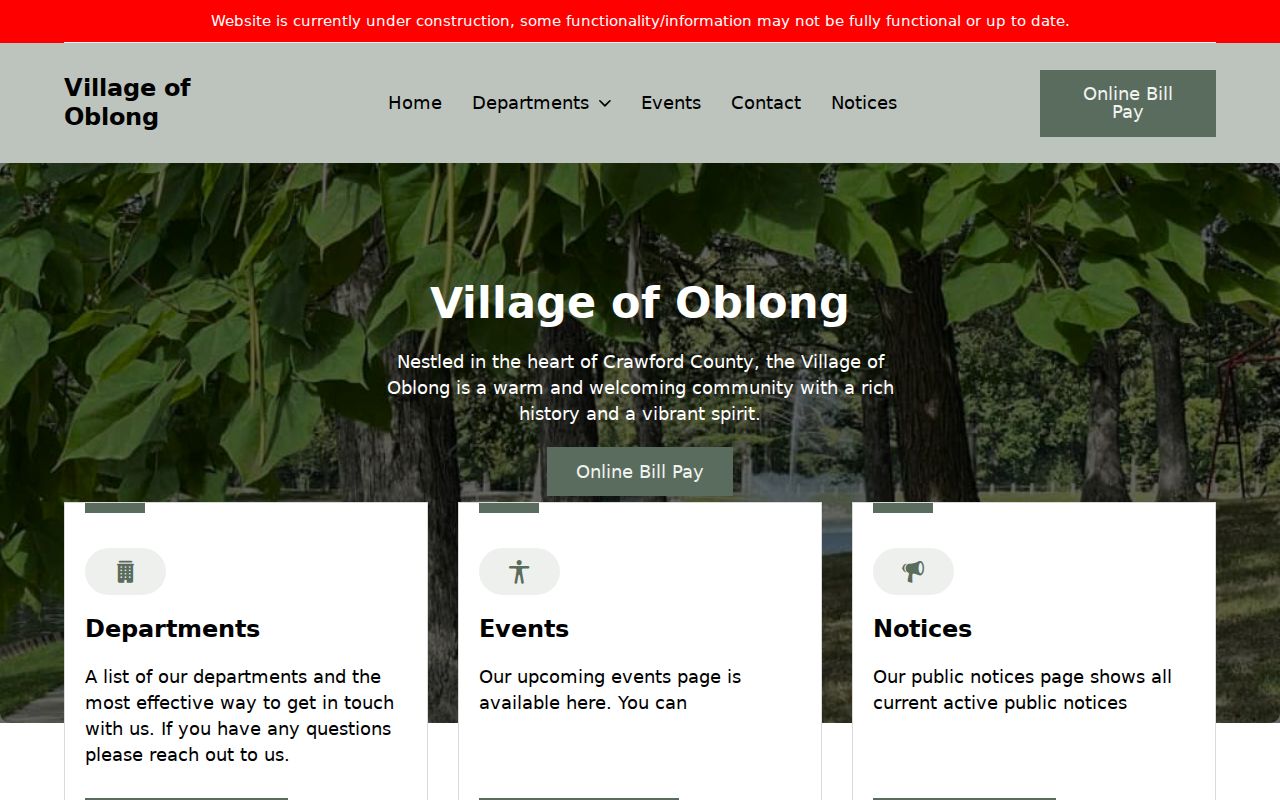
The official Oblong homepage supplies Village Hall context and current notices.
Records at the Oblong Police Department
Oblong Police is at 202 South Range Street, Oblong, IL 62449, phone 618-592-4715. County dispatch is 618-546-1515 extension 0, and emergencies go to 911. Village Hall publishes 618-592-3122 and info@villageofoblong.com. Two visible hour ranges conflict: an 8:00 to 5:00 header and an 8:00 to 1:00 Hall contact listing. Call before visiting.
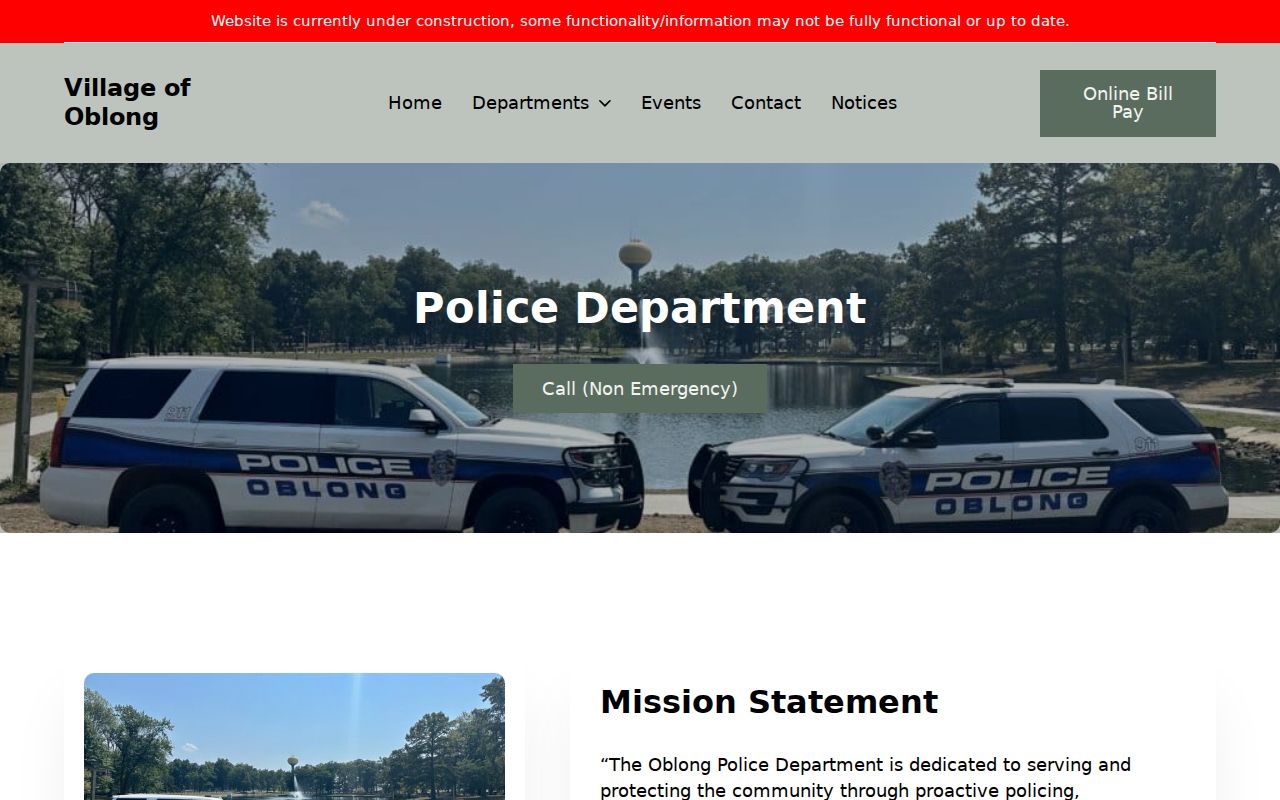
The official Oblong Police page provides the department location and contacts.
No Online Blotter: Oblong's Fallback
Ask the department whether the requested record is readily available or requires FOIA, who currently serves as FOIA officer, and which email, mailing, fax, or in-person route is preferred. Describe an identifiable record rather than requesting “everything” about a person. Illinois FOIA requires existing records; it does not require the village to create a criminal-history report that it does not maintain.
Police may redact protected personal information, victim or juvenile details, active-investigation content, and other exempt material. A partial release with redactions is not necessarily evidence that the entire event is secret.
Booking and Arrest Records in Oblong
An Oblong arrest can create several records at different times. Police makes the incident or arrest report. Crawford County Jail at 203 South Jefferson Street in Robinson creates the intake record. A prosecutor may later file a case, and the Circuit Clerk then maintains the docket and orders. A booking charge is an intake allegation, not a conviction, and may differ from later filed counts.
Record flow: Oblong Police › Crawford County Jail › Crawford County Circuit Court › Illinois State Police
For current custody or a booking sheet, use Arrest Search. For the judicial result, use the court route even after release from jail.
Dog, Vehicle, and Stop-Sign Records
Village notices concerning dog restraint, inoperable vehicles, and a 2025 stop-sign measure illustrate how local enforcement can produce warnings, citations, council records, or filed ordinance cases. The ordinance text and meeting action explain the local rule; they do not prove that a named person was cited. Police holds its enforcement report, and a filed citation belongs in the county court docket.
Community events such as the Crawford County Fair and Fall Follies may generate temporary traffic or patrol activity. Event context should never be converted into an unsupported claim about crime or individual guilt.
The Oblong Municipal Court File
Oblong does not operate a separate municipal court. Filed ordinance, traffic, misdemeanor, and felony matters go to Crawford County Circuit Court in Robinson. Judici provides the county docket search, described as current from 1992 forward. The Circuit Clerk supplies unavailable documents, certified copies, and older-file assistance.
| Court Name | Crawford County Circuit Court |
|---|---|
| Case Types Heard | Ordinance, traffic, misdemeanor, felony, and other trial matters |
| Case Lookup Channel | Judici, followed by the Circuit Clerk |
| What the Docket Shows | Parties, counts, events, orders, disposition, sentence, and ledger details as available |
| Copies & Fees | Current charges must be confirmed with the clerk |
The official Crawford Judici entry provides county case searching.
How Oblong Records Reach the County
A village referral can be correct. Police reports remain in Oblong, but bookings, court documents, prosecution records, and statewide histories are maintained elsewhere. The county department directory helps identify the sheriff, jail, Circuit Clerk, State's Attorney, and probation office.
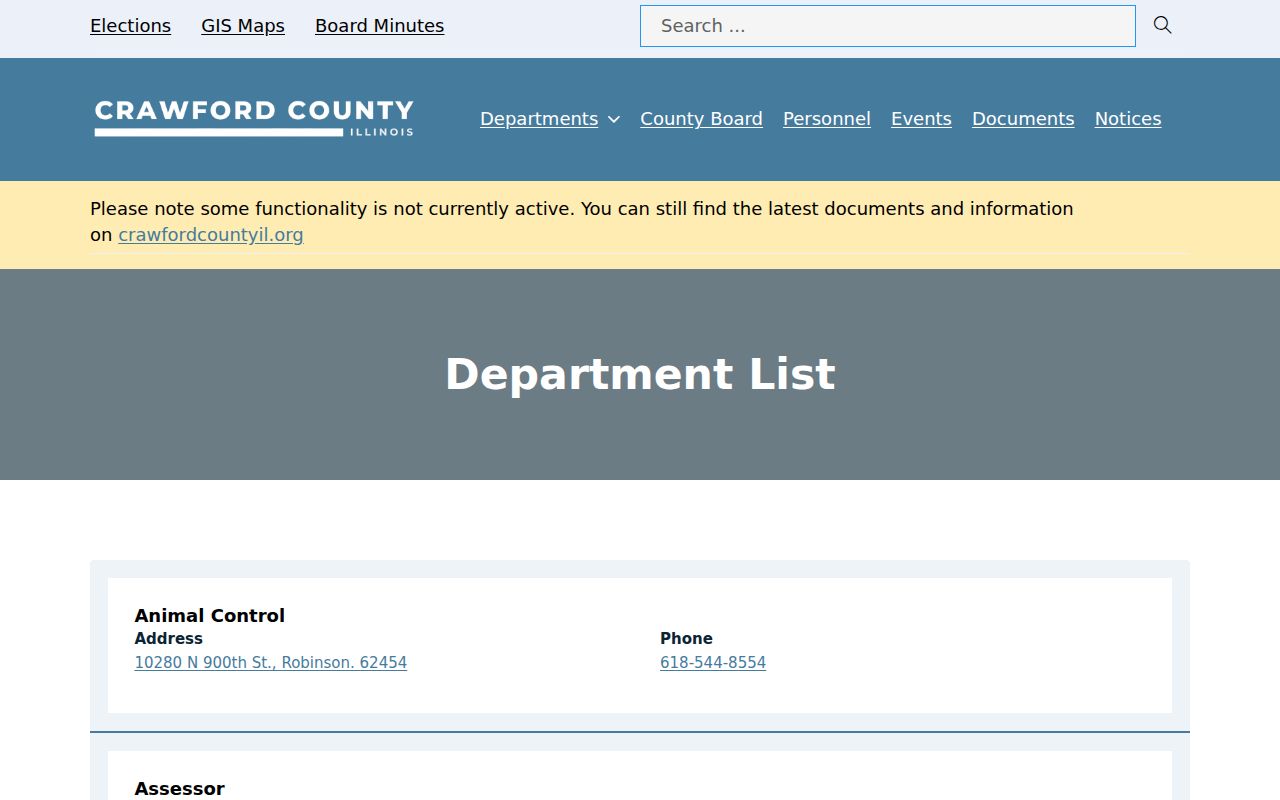
The official Crawford County department directory identifies those county custodians.
Oblong's UCR Verification Flag
Historical ISP tables showed 32 index offenses in 2014 and 22 in 2016 for Oblong, but the 2014 data carried a nonverified “N” flag. These are old agency-reported offense counts, not current conditions, arrests, convictions, or a basis for judging a person. The flag and changes in reporting make trend claims especially unreliable.
Local ordinance research requires two kinds of documents. A village notice identifies the rule, while a police report or filed citation shows whether officials applied it in a particular event. The 2025 stop-sign notice, dog-restraint provisions, and inoperable-vehicle rules provide legal context. They are not person-specific criminal histories and cannot prove that a resident violated a rule.
Oblong's parks, county fair, and Fall Follies explain periods when public spaces may receive additional attention. They do not establish current crime. If an event generated a report, request it from Police. If it generated a filed citation, use the Crawford docket. This preserves accuracy and village-level focus.
Reading Oblong Results Across Systems
A police report, booking, docket, and statewide history have different purposes. Police describes the reported event and investigation. Jail intake captures the listed arrest charge and custody facts. The docket records filed counts, hearings, orders, and disposition. ISP receives qualifying arrest and disposition submissions. A delay or difference between them should be investigated by date, agency, and case number rather than filled with assumptions.
“Pending” is not a conviction. “Disposed” does not reveal which count was dismissed or sustained. A release from jail does not close the prosecution. Likewise, failure to find a name in a current roster does not establish that no prior Oblong arrest occurred. Ask the responsible custodian for the historical record that fits the question.
Public copies may omit victim information, juvenile material, full birth dates, Social Security numbers, investigative details, and sealed information. Narrow requests often produce clearer responses because the village can identify the record and assess exemptions. If a denial occurs, review the stated exemption and appeal route rather than resubmitting the same broad wording.
Before visiting, confirm which published Village Hall hour range is current. Bring a written description even if staff accepts an oral question. Written details reduce confusion about dates, locations, format, inspection, copies, and certification. Ask for a cost estimate because the absence of a posted police fee table does not establish that every format is free.
After-hours dispatch can route an urgent law-enforcement concern, but it is not a records counter. Do not call 911 for routine requests. For a background question spanning Illinois, an Oblong report is too narrow. CHIRP provides public conviction information, while fingerprint-based Access and Review allows a person to inspect and challenge their own repository history.
Sealing and expungement can explain a missing public result. Sealing retains qualifying material while removing it from ordinary public response, subject to statutory access. Expungement has a different legal effect. Only official records and court orders establish whether relief was granted; a blank online search cannot.
A report request should also separate police-created material from county records. Oblong cannot produce a sheriff report, jail booking sheet, prosecutor file, or clerk pleading merely because the underlying event occurred in the village. A precise referral is part of a correct search, not a failure of public access.
At the court stage, read each count and its disposition. One case can contain a conviction, a dismissal, and supervision on different counts. A single overall status hides that detail. Financial ledger information may show assessments or payments but does not replace the sentencing order. Ask the clerk for the document needed to answer the actual question.
For current custody, confirm a roster match with the jail when identity or release timing matters. Crawford houses detainees connected to neighboring counties, so presence in the county facility does not prove an Oblong arrest or Crawford prosecution. The booking agency, holding agency, and prosecuting county can differ.
A record check should end with verification, not publication of an unconfirmed match. Record the official source, access date, identifiers used, and any limitations. Recheck time-sensitive custody and registry information close to the decision or safety need. Do not use this public research for employment, housing, credit, insurance, or another FCRA-regulated eligibility decision.
Oblong's small local system rewards specific requests. A narrow date range, street, incident type, and report number can help staff locate responsive material without sweeping through unrelated records. If the village says another agency owns the item, note the referral and contact that office with the same identifiers. This creates a traceable search without turning gaps into unsupported conclusions.
Inspection, Copies, and Certification in Oblong
When no village police fee table is posted, ask whether inspection, emailed files, plain paper copies, or certified copies are available and request an estimate. Inspection can help identify a few responsive pages before reproduction. Certification should be ordered only if the eventual recipient requires it. A village-certified police report is not a certified court disposition, so obtain the latter from the Circuit Clerk. Keep the response letter with the released pages because it documents redactions and the scope of the search.
Oblong Record Access Rules
Illinois FOIA applies to village and police records, generally requiring an initial noncommercial response within five business days. Exemptions can protect investigations, juveniles, victims, private information, and safety-sensitive material. Judicial access rules govern the court file, while sealed and expunged records are withheld from ordinary public response.
Key Statutes:
Illinois Freedom of Information Act, 5 ILCS 140 governs requests to the village and police.
Criminal Identification Act, 20 ILCS 2630 governs Illinois criminal-history collection and access.
20 ILCS 2630/5.2 governs expungement and sealing effects.